
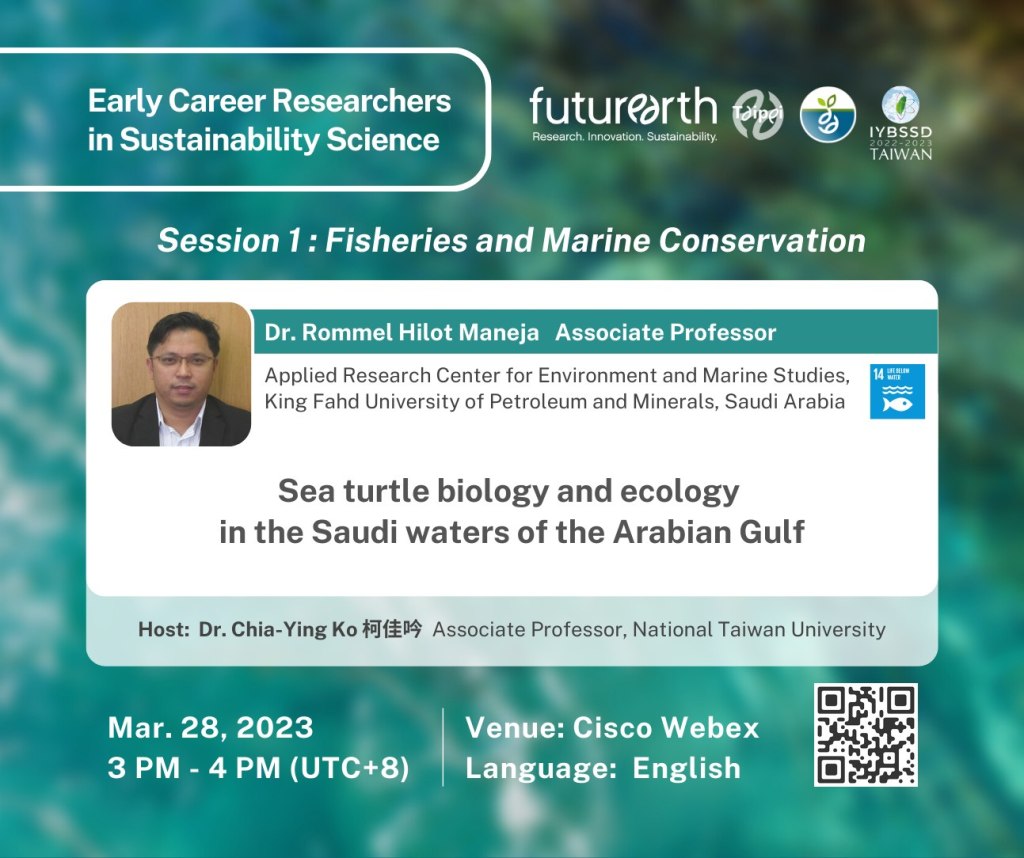
28 March 2023 15:00 – 16:00 (UTC+8)
【Webinar】ECRs in Sustainability Science, Session 1: Fisheries and Marine Conservation
S1-3 Sea turtle biology and ecology in the Saudi waters of the Arabian Gulf
Speaker|Dr. Rommel Hilot Maneja (Associate Professor / Research Scientist II at Applied Research Center for Environment and Marine Studies, King Fahd University of Petroleum and Minerals 沙烏地阿拉伯法赫德國王石油礦產大學副教授)
Host | Dr. Chia-Ying Ko 柯佳吟 (國立臺灣大學漁業科學研究所副教授)
Register|https://pse.is/4s5ljt
Sea turtles are an integral component of the marine ecosystem in the Gulf. They maintain the productivity of the seagrass meadows and the health of the coral reefs. They also enhance nutrients transport among distant habitats. The sea turtle research is composed of interdisciplinary studies designed to examine the ecological status and threats of sea turtles in the study area.
Abstract
The outcomes of the previous Sustaining Research Projects (SRPs), over the past 36 years, have paved the way for KFUPM and Saudi Aramco to continuously monitor the marine ecology of the Saudi waters of the Arabian Gulf and have provided a wealth of scientific information on the fauna and flora in the region. Sea turtles are an integral component of the marine ecosystem in the Gulf. They maintain the productivity of the seagrass meadows and the health of the coral reefs. They also enhance nutrients transport among distant habitats. Recognizing the value of sea turtles, KFUPM and Saudi Aramco have included the Sea Turtle Research as one of the work packages of the Sustaining Research Project (SRP), both during the Phase VI and VII. The sea turtle research is composed of interdisciplinary studies designed to examine the ecological status and threats of sea turtles in the study area. Satellite and acoustic telemetry will be utilized to follow the movements of all three developmental stages (hatchling, juvenile, and mature) of sea turtles and identify the connectivity of their essential habitats. The levels of light pollution that reach the offshore turtle nesting islands will be assessed including the examination of its impacts on the behavior and orientation of hatchling turtles. In this seminar, the scope of work, mobilization, and research plans for the sea turtle research will be presented. In addition to the original proposed (committed) tasks, the research will strive to conduct in-depth extra studies that will enhance the ecological assessment of the sea turtle habitats by employing state-of-the-art technologies. Among these, Real Time Kinematic (RTK) Survey will be conducted to establish the high-resolution topographic map of the turtle nesting island. Additionally, Ground Penetrating Radar (GPR) will be performed to assess the erosion/accretion dynamics of the island beach, which affects the suitability of the beach for turtle nesting. Predation pressure on sea turtle hatchlings coming from the invasive mice population will be assessed. Overview of the results of the SRP-Phase VI will also be discussed.
 Future Earth Taipei ECR