
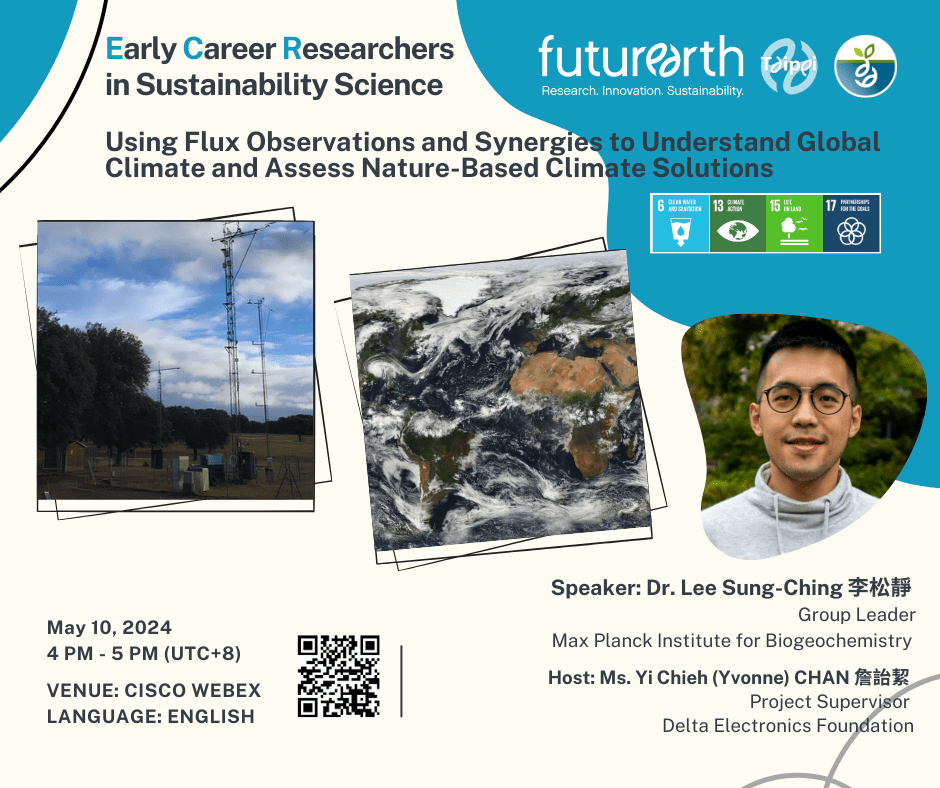
Using Flux Observations and Synergies to Understand Global Climate and Assess Nature-based Climate Solutions
Speaker|Dr. Lee Sung-Ching 李松靜 (Group Leader, Max Planck Institute for Biogeochemistry)
Date|10th May 2024
Time|16:00 – 17:00 (GMT+8)
Language|English
Register|https://rb.gy/b1pw3g
ABSTRACT
Stabilizing global climate change requires a rapid reduction in greenhouse gas (GHG) emissions and protection of long-term benefits provided by ecosystems. Nature-based climate solutions (NbCS) have been proposed to harness the photosynthetic power of ecosystems to avoid GHG emissions and/or remove carbon dioxide (CO2) from the atmosphere, and preserve biodiversity and food quality. Eddy covariance is the only method that provides direct and continuous high-frequency measurements of GHG exchange between ecosystems and the atmosphere, but has only occasionally been applied to study the GHG dynamics associated with specific NbCS strategies.
Using long-term eddy-covariance data collected in different ecosystems around the world, I will share what lessons have been learned about the impact of ecosystem disturbance (e.g., harvesting and wildfire smoke) and the management of ecosystem recovery (e.g., peatland restoration and saltmarsh conservation) on GHG and water vapour exchange. Additionally, to unlock the potential of flux data, I have connected tower-based with proximal remote sensing, satellite data, and machine learning methods. Furthermore, to demonstrate the greater power of flux data, I will present results that connect flux observations to sap flow measurements of species-specific transpiration, lysimeter measurements of non-rainfall water input, and vegetation composition for biodiversity assessment. To integrate additional ground observations with flux data, hybrid modeling (i.e., the combination of process-based models and machine learning) have been proposed and I will present an example to show the effectiveness of this strategy. The examples presented in this talk show there is great promise in developing a data-knowledge continuum to create a robust NbCS framework that can make a major contribution to climate change mitigation and maintaining healthy ecosystems.
Host|Ms. Yi Chieh (Yvonne) CHAN 詹詒絜 (Project Supervisor, Delta Electronics Foundation 台達基金會)
✦ Organizers /
– ECR working group, Future Earth Taipei
– Future Earth Taipei Hub
– IYBSSDXTAIWANIYBSSDXTAIWAN
– 中央研究院 永續科學中心 Center for Sustainability Science
 Future Earth Taipei ECR