
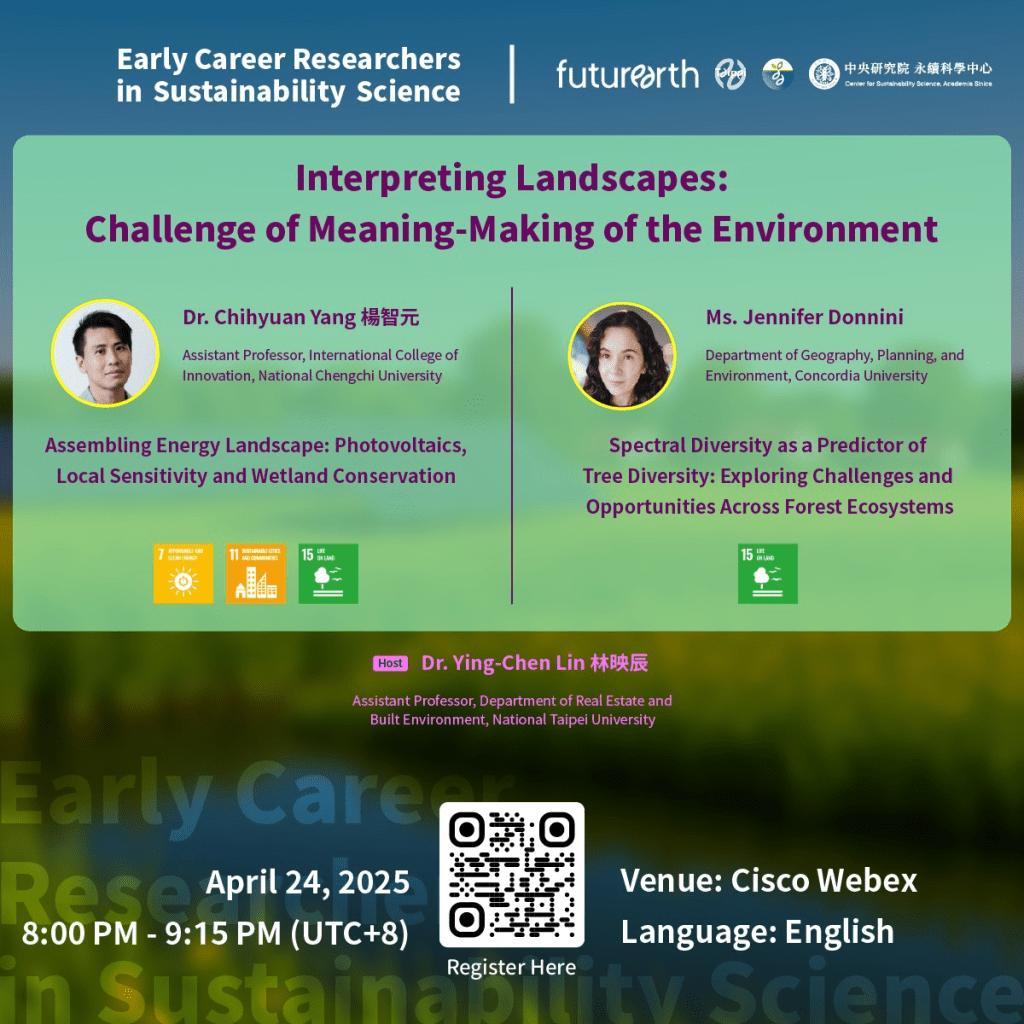
【Webinar】Interpreting Landscapes: Challenge of Meaning-Making of the Environment
Speaker|Dr. Chihyuan Yang 楊智元 (Assistant Professor, International College of Innovation, National Chengchi University 國立政治大學創新國際學院 助理教授)
Assembling Energy Landscape: Photovoltaics, Local Sensitivity and Wetland Conservation
Taking the material conditions and sensory dimensions seriously, an energy landscape is perceived as a specific mode of valuing and combining the senses with the environment and material things in a specific cultural context (Howes, 2005; Olwig, 2002; Ingold, 1993); landscape, artefacts and social life are mutually constitutive in the emergence of assemblages (Latour, 2005). The sensory interaction between technology and humans filling the environment causes the meaning of the energy landscape to differ, which means it is a contested concept subjecting to differing interpretations. Sensory groups and ethno-epistemic assemblages (EEAs) (Irwin & Michael, 2003) around the installations are crucial to the meaning-making of renewable energy (RE) technology.
Two cases in Taiwan are documented below to illustrate this point. PV greenhouse designed in the aftermath of Typhoon Morakot exemplifies assembling RE technology locally, which can be understood as establishing connections among local environments, materiality and attachments while negotiating and experimenting with the most practical and acceptable formations of installations. Under these PV greenhouses, young people are conjured along with PVs, vegetables, steel frames, and gusty winds, forming the assemblage reflecting local concerns.
Under the policy target of zero-emission, large-scale PV installation was planned for Budai’s abandoned salt pans, which serve as an interconnecting habitat for migratory birds. To ensure habitat management, a group formed by the central and local governments, NGOs, associations, renewable energy developers, and local participants created a conservation plan; 30% of the contracted area was reserved for ecological conservation and entrusted to a local NGO for close habitat management.
Speaker|Ms. Jennifer Donnini (Department of Geography, Planning, and Environment, Concordia University)
Spectral Diversity as a Predictor of Tree Diversity: Exploring Challenges and Opportunities Across Forest Ecosystems
Forests are crucial for ecosystem health, climate regulation, and biodiversity. However, many tree species face extinction threats, requiring active monitoring for conservation. The spectral variation hypothesis (SVH) suggests that spectral diversity can serve as a proxy for ground-measured biodiversity. Despite its promise, SVH’s application has shown inconsistent results, complicating its use in biodiversity monitoring. Our recent study examines the relationship between tree diversity and Sentinel-2-derived spectral diversity across Quebec’s forests, analyzing 2531 inventory plots using a combination of spectral analysis, cluster analysis and random forest (RF) regressions. We evaluated four biodiversity indices: species richness, Shannon diversity, functional dispersion, and percent conifer. Our analysis revealed overlapping spectral signatures that make it challenging to differentiate between varying levels of species richness, Shannon diversity, and functional dispersion. However, percent conifer shows spectral separability and can be stratified using unsupervised k-means clustering. Using RF regression models, only the percent conifer models demonstrated strong performance (R2 = 0.77), while models for the other biodiversity indices did not exceed an R2 of 0.46. This study highlights the complex relationship between spectral diversity and tree diversity and suggests that future research should aim to improve the understanding of the relationship, or lack thereof, between ground-measured biodiversity indices and relatable spectral metrics.
Host |Dr. Ying-Chen Lin 林映辰 (Assistant Professor, Department of Real Estate and Built Environment, National Taipei University 國立臺北大學不動產與城鄉環境學系 助理教授)
Date|24 April 2025
Time|April 24, 2025 (Thursday) 20:00 – 21:15 (UTC+8)
Language|English 英文
Register|https://pse.is/7btllr
✦ Organizers /
– ECR working group, Future Earth Taipei
– Future Earth Taipei Hub
– IYBSSDXTAIWANIYBSSDXTAIWAN
– 中央研究院 永續科學中心 Center for Sustainability Science
 Future Earth Taipei ECR